
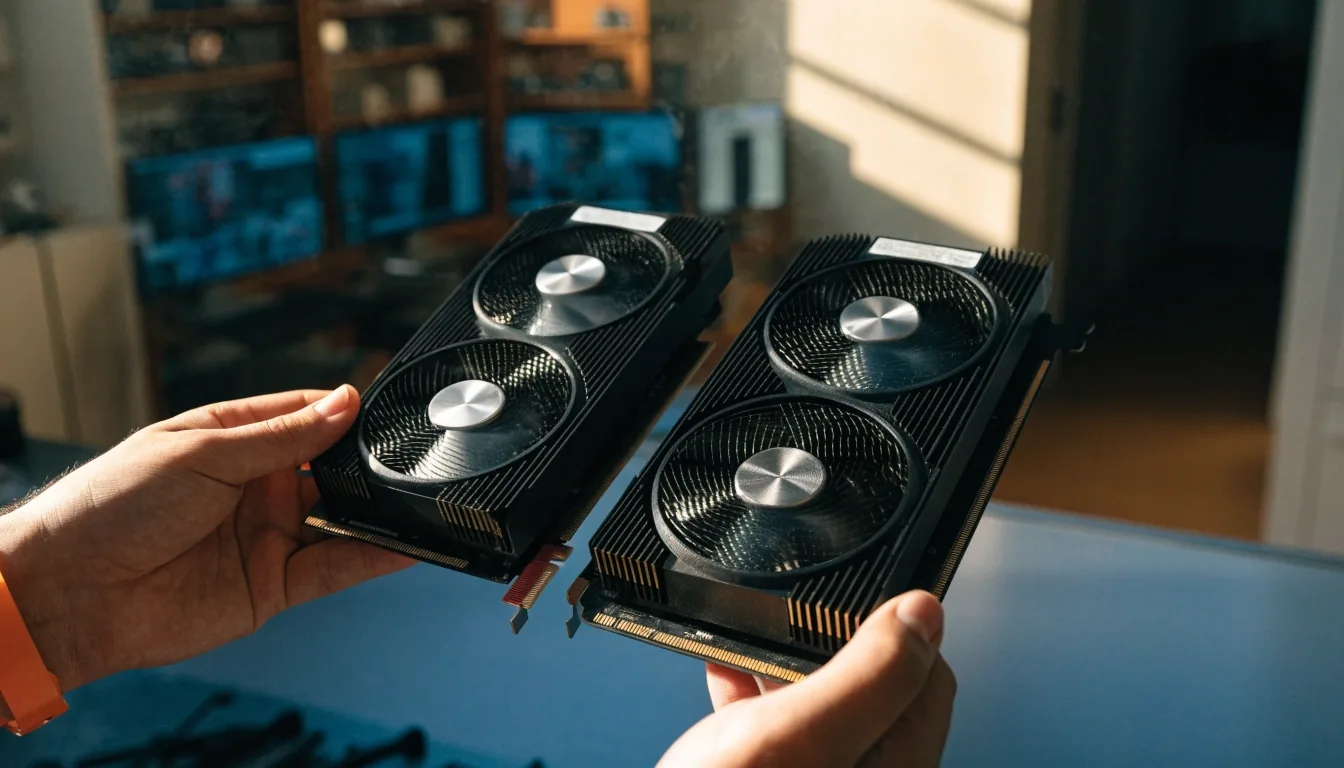
Comparison sheet · Busan counter
Compare four GPUs before you buy
The NVIDIA GeForce RTX 5070, the AMD Radeon RX 9070, the older Radeon RX 7800 XT and the Intel Arc B580 do not sit at the same price, so price alone sends people home with the wrong card. Here they line up on frames at your monitor's resolution, memory size, and what each one actually costs in Korea.
Four cards, one sheet
Where each card belongs
A 1080p card and a 1440p card are not the same purchase wearing different prices. Read the row that matches your monitor first.
-
NVIDIA GeForce RTX 5070 12 GBTriple-fan1440p / 4K headroom≈ 1,100,000 12 GB Triple-fan 1440p
-
AMD Radeon RX 9070 16 GBTriple-fan1440pOn request 16 GB Triple-fan 1440p
-
AMD Radeon RX 7800 XT 16 GBDual / triple-fan1440p valueStock-dependent 16 GB Dual / triple 1440p value
-
Intel Arc B580 12 GBDual-fan1080pEntry tier 12 GB Dual-fan 1080p
Prices move with memory cost and stock. Check the catalog for what is on the shelf today.
Set your resolution first
Comparison only works once the target is fixed. The Arc B580 belongs in a 1080p conversation. The RX 7800 XT, RX 9070 and RTX 5070 are 1440p cards, with the RTX 5070 offering some 4K headroom. Comparing a 1080p card with a 1440p card on price alone is the fastest way to buy the wrong thing.
Pick the row that matches your monitor, then compare inside that row. If your monitor is still undecided, the row is the wrong thing to break first — resolution decides how much the rest of the machine has to carry, from the power supply to case airflow.
- 1080p monitors Arc B580 · entry Radeon / GeForce
- 1440p monitors RX 7800 XT · RX 9070 · RTX 5070
- 4K monitors Above this group — talk it through

RTX 5070 vs RX 9070
This is the live midrange decision. Both are current-generation 1440p cards; the RTX 5070 brings DLSS, frame generation and ray tracing as its pitch, while the RX 9070 sits in AMD's RX 9000 series for performance buyers who skip the top tier. In Korea, availability often decides it: Radeon RX 9000 distribution arrives in waves, so one card may be weeks away while the other is on the shelf.
NVIDIA GeForce RTX 5070
Current generation · 1440p with 4K headroom
The card you reach for when upscaling and frame generation matter to your games list. Ray tracing is the strongest argument here, and drivers have had the longest runway of the four. The trade is price: Korean listings moved during the year as memory costs pushed up, so a number you remember from launch may not be the number on the shelf.
- Memory 12 GB
- Upscaling DLSS · frame gen
- Reports in Korea ≈ 1.1 million KRW
- Availability On the shelf
AMD Radeon RX 9070
RX 9000 series · 1440p
AMD's answer for buyers who care about frames per won and skip the halo tier. More memory than the RTX 5070 at this tier, weaker ray tracing, and a distribution rhythm that arrives in waves in Korea. If it is stocked, it competes hard. If it is not, waiting is a real cost.
- Memory 16 GB
- Upscaling FSR · frame gen
- Availability Arrives in waves
Which fits your build comes down to which pitch you actually use. If ray tracing and DLSS carry weight in your games list, the GeForce side is the cleaner answer. If raw frames at 1440p matter more than feature coverage, the Radeon side spends the money better — as long as one is in stock the week you are ready to buy.

RX 7800 XT vs RX 9070
AMD against itself, one generation apart. The RX 7800 XT is the prior-generation card that still turns up in 1440p value conversations, and when it is discounted or left over as stock it can win on price for the frames it delivers. The RX 9070 pulls ahead on newer features and ray tracing. If your budget is fixed and features are flexible, the older card deserves a real look rather than a dismissal.
The honest test is not which is newer. It is which one is on the shelf at a price you would pay this month, with a warranty you can actually use.
-
Generation Prior gen RX 9000
-
Ray tracing Weaker Stronger
-
Buying window Leftover stock In waves
-
Value at 1440p Strong when discounted Strong at list
Arc B580 vs the entry cards
The Intel Arc B580 is Intel's entry-level option in the Arc B-series, and it competes with cheap new Radeon and GeForce cards rather than with the 1440p group. Its appeal is being a new card at a low price, with driver maturity that has improved over the first Arc generation.
For a 1080p first build it is a serious candidate. For 1440p it is out of its lane.
Where the entry tier makes sense
- A first 1080p build Right card for the resolution, and the cheapest way into a new, warrantied GPU.
- A small case with modest power Short two-fan coolers fit tight builds and pair with lower-wattage supplies.
- 1080p at high refresh Competitive frames per won at 1080p once drivers are up to date.
- Not a 1440p replacement You will be lowering settings, so we point that resolution higher.
VRAM across all four
Memory capacity separates these cards as much as brand does. 8GB is a 1080p size in practice, which is where the B580 sits in many builds. 12GB is a workable 1440p floor. 16GB gives room for texture packs and a longer useful life, and it is the safer bet if you keep cards for years.
Buying under your resolution's VRAM needs does not show up as a slightly lower average frame rate. It shows up as stutter when a game streams textures in, which is harder to live with and harder to fix later. If you plan to keep one card for three or four years, the memory column is the one to weight heaviest.
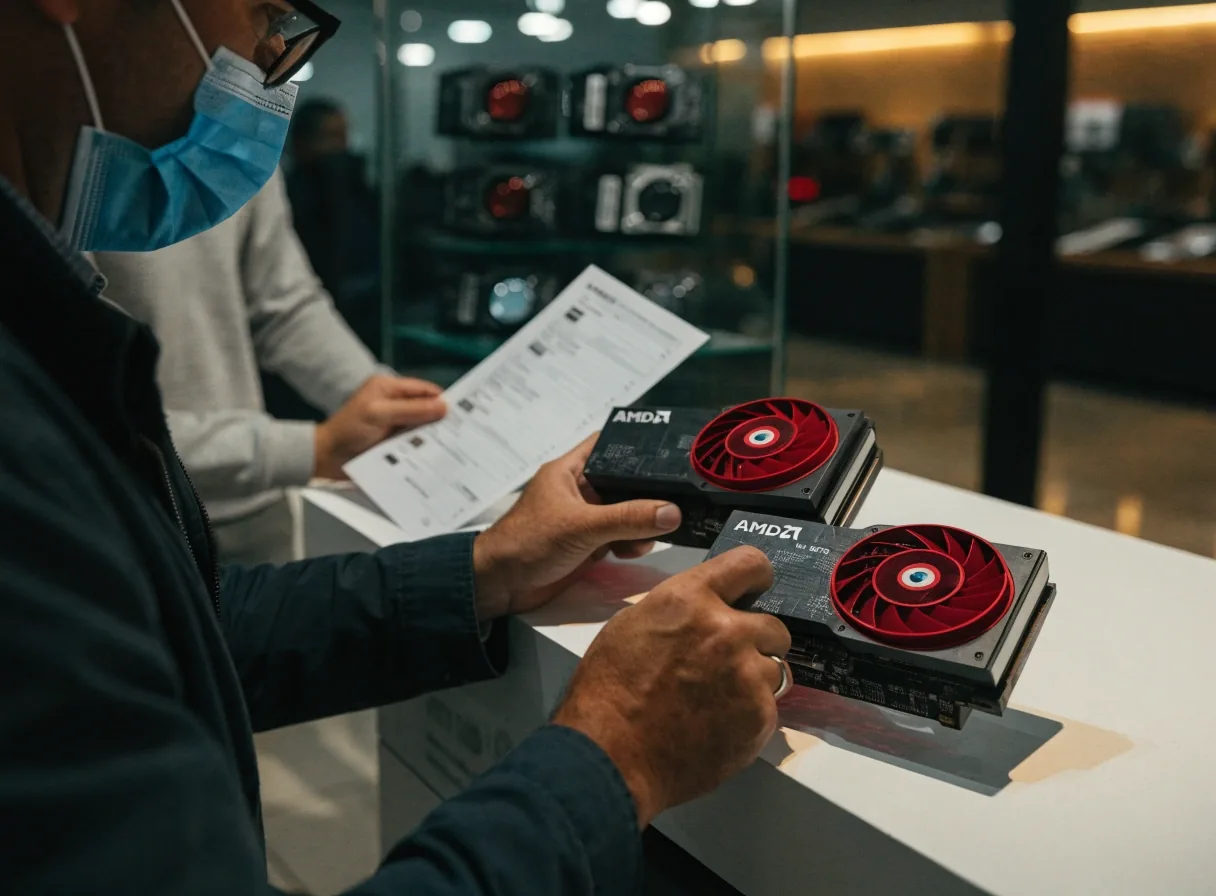
Memory by card — swipe for the full row
Price in Korea, not launch price
Local prices respond to memory costs, import conditions and retailer stock. Korean coverage in 2026 reported the RTX 5070 around 1.1 million KRW in some listings after increases, and tied part of the RTX 50 price pressure to rising GDDR7 memory costs, with Samsung and SK Hynix among the producers.
That is why a cheap number you saw at launch may not exist now. A GPU price tracker is useful for spotting a trend, not for planning a purchase weeks ahead — the listing you can buy from today is the only price that matters, and it can shift within a single stock cycle. Check current listings rather than a launch review from another market.
When you compare at our counter, bring the price you found and we will tell you whether it is still live, and whether the card behind it fits the rest of your build. A lower price on a card your power supply or case cannot take is not a saving.

Shelf price this week, not the review price
When a used card beats all of them
The GeForce RTX 30 series still sells second-hand, and it becomes the fallback comparison whenever new cards rise. A used 30-series card can hold a 1440p build for less money — with no warranty, and with a history you cannot fully check. A used RTX 40-series card can also undercut a new current-generation model.
Value is not always a new box. What changes is the risk: an unknown history, thermal paste that may or may not have been refreshed, and no manufacturer cover if something fails next year.
We inspect the used cards the shop handles before they go on the shelf, and we tell you plainly what was checked and what stays unknown. That is the difference between a good second-hand purchase and a gamble you did not agree to.
Used vs new at a glance
How to use this comparison at the counter
Bring three numbers with you. With those, we can tell you which of the four actually fits, and which one is worth the money for your setup. Comparison is not a spec sheet contest — it is matching a card to the machine already sitting under your desk.
Come to 15, Centum 1-ro in Haeundae-gu with the machine or the numbers, open Monday to Friday 09:00–18:00, or call +82-51-740-2211 and we will narrow the row before you travel.
-
01
Monitor resolution and refresh rate
This picks your row before anything else is discussed.
-
02
PSU wattage and connectors
A card you cannot power is a card you cannot use, however good the price.
-
03
Case clearance in millimetres
Long triple-fan coolers often decide the shortlist by themselves.
-
04
Current stock and listing
The week's price, the week's availability, and whether the card ships with the bracket you need.
Questions we get at the counter
The three that come up most when someone is deciding between these four cards.
-
Which is better for 1440p, the RTX 5070 or RX 9070?
Both are current 1440p cards. The RTX 5070 leans on DLSS and ray tracing, the RX 9070 on raw performance for the tier. Availability in Korea often tips the decision.
-
Is the RX 7800 XT still worth buying?
Yes when it is discounted or in leftover stock. It stays competitive on 1440p value, with weaker ray tracing and fewer new features than RDNA 4 cards.
-
Can the Arc B580 handle 1440p?
It is a 1080p card. At 1440p you would be lowering settings, so we point that resolution higher.
Which card does your machine actually take?
Tell us your resolution, power supply and case clearance, and we will narrow these four to the one that fits. Or check what is on the shelf today before you travel to Haeundae-gu.
Quandrel Graphics Store · 15, Centum 1-ro, Haeundae-gu, Busan · Mon–Fri 09:00–18:00 · +82-51-740-2211